Products and configurations to compare
100Ah smart LiFePO4 Group 24
A current Group 24 reference packs 1.28kWh nominal into a small case.
Best when: weekend/low-inverter use and easy recharge
Watch for: 100A BMS may limit very large inverter loads depending on battery/system
200Ah smart LiFePO4 RV battery
Doubling storage without doubling charging can simply create longer recharge times.
Best when: daily consumption regularly exceeds ~1kWh
Watch for: heavier, more expensive and slower to recharge with small solar
Battery monitor shunt
Measure before expanding.
Best when: you want measured daily energy use
Watch for: requires correct installation/configuration
Amp-hours hide voltage
Compare watt-hours when mixing 12V, inverter and appliance loads.
Battery size and inverter size are separate
A huge bank does not automatically support a huge inverter if BMS/cables cannot supply the current.
Recharge rate sets usable trip length
A 200Ah bank with 200W solar can remain perpetually undercharged under heavy use.
Furnace blowers surprise winter campers
Propane supplies heat, but the 12V blower can be a major overnight electrical load.
Expansion later can be cleaner than guessing now
Choose a battery architecture that allows safe matched expansion if your system supports it.
State of charge is not the same as battery voltage
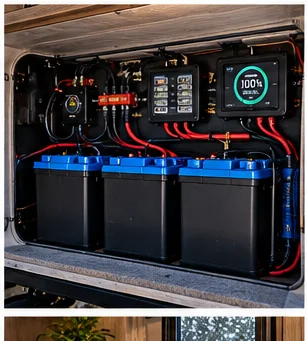
Under load, voltage sags; while charging, voltage rises. Lithium batteries also maintain a relatively flat voltage across much of their usable capacity. A shunt-based monitor measures current entering and leaving the bank and can estimate state of charge more meaningfully than a simple voltmeter once configured correctly.
Bluetooth inside the battery BMS can be useful, but it sees only that battery. A system shunt can measure the entire bank and all loads/charging paths wired through it. In a multi-battery installation, architecture matters more than app screenshots.
Lithium upgrades are system upgrades
Converter/charger profile, solar controller, alternator charging, low-temperature charging behavior, cable size, fusing and inverter demand all need to be compatible. A drop-in-size battery can physically fit while the rest of the electrical system remains wrong for it.
Before checkout
- Exact RV voltage, amp service and existing component model are known
- Physical dimensions and service access are measured
- Wire, hose, port and fitting sizes are confirmed before ordering
- Product duty cycle/output matches the real worst-case load
- Cold-weather requirements are considered
- Consumables and replacement parts remain available
- Installation does not defeat factory protection or ventilation
- Mobile-app features are not required for basic emergency operation
- Return policy allows a real fit/compatibility check
- Professional installation cost is included where appropriate
Fitment and installed cost matter more than the sale price
RV equipment rarely exists in isolation. A cheaper pump that needs new fittings, a lithium battery that forces a converter change, a soft start that needs professional rooftop labor or an inverter that requires new cable/fusing can cost more installed than the premium part that actually matches the rig. Write down the entire install list before comparing prices.
Also measure service access. Components eventually need filters cleaned, bolts checked, firmware/app access, batteries changed or hoses disconnected. An installation that technically fits but cannot be serviced without dismantling a cabinet is not a good installation.
First-trip test
Test new systems close to home before depending on them several states away. Inflate every RV tire, run the pump through several faucets, cycle the AC repeatedly on the intended generator, dump through the sanitation setup, or run the inverter under realistic loads. Watch for heat, voltage drop, leaks, vibration, nuisance alarms and connection loosening. Fix those problems before the long trip.
Keep the old functional component when practical until the replacement survives that shakedown. A known-working pump, charger or level can be valuable backup while a new installation is still proving itself.
Frequently asked questions
How many watt-hours is 100Ah at 12.8V?
About 1,280Wh nominal.
Is 200Ah twice the runtime?
Approximately for the same loads and conditions, but inverter/charging losses and BMS limits still apply.
How do I know my daily use?
Use a shunt/energy meter over representative days.
Should I size from solar panels?
Size battery and charging together; storage without recharge capacity can be frustrating.
Current manufacturer/source checks
Affiliate disclosure: RVGear.co is reader-supported. Amazon links use Associates tag scouttheory-20 and eBay links use Partner Network campaign 5339137014. We may earn a commission at no extra cost to you.