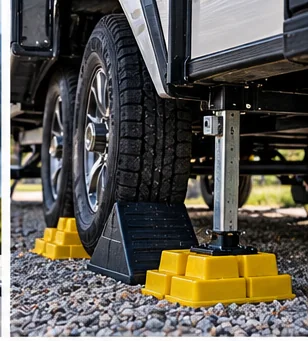
Products and configurations to compare
Andersen Camper Leveler 3604 pair
Current product is intended for drive-on leveling and chocking.
Best when: tire spacing and ground allow the curved ramp
Watch for: some tandem axles have tight spacing; verify fit and trimming guidance
Stackable RV leveling blocks
Useful beyond leveling, especially under jacks on soft ground.
Best when: you need tire/jack pads and flexible stack shapes
Watch for: more trial-and-error to hit exact height
Rubber jack/leveling pads
Spread load and reduce sinking.
Best when: you camp on soft/asphalt surfaces
Watch for: do not create large correction height alone
Fine adjustment is the curved-leveler advantage
You are not locked to discrete one-inch block layers.
Blocks win versatility
They can support tires, tongue jack and stabilizers when rated appropriately.
Tandem spacing can be the deal breaker
Measure tire gap and fender/underbody clearance before ordering.
Soft ground changes everything
A narrow hard edge can sink; broad pads/blocks distribute load.
Always chock before unhitching
Leveling hardware does not replace wheel chocks.
Leveling and stabilizing are different jobs
Leveling corrects side-to-side and front-to-back attitude. Stabilizers reduce movement after the RV is level. Do not use ordinary stabilizer jacks as lifting jacks unless the manufacturer explicitly designs them for that load. Trailer tires should be supported on a stable surface, with appropriate chocking before unhitching.
A digital leveling tool tells you how much correction is needed; curved levelers or blocks physically create the correction. The measurement tool and the leveling hardware therefore complement each other rather than compete directly.
Site assessment saves more time than fancy blocks
Before unhitching, look at slope, soft ground, utilities and slide clearance. If you can reposition a foot to reduce the correction from four inches to one inch, do that before stacking hardware.
Before checkout
- Exact RV voltage, amp service and existing component model are known
- Physical dimensions and service access are measured
- Wire, hose, port and fitting sizes are confirmed before ordering
- Product duty cycle/output matches the real worst-case load
- Cold-weather requirements are considered
- Consumables and replacement parts remain available
- Installation does not defeat factory protection or ventilation
- Mobile-app features are not required for basic emergency operation
- Return policy allows a real fit/compatibility check
- Professional installation cost is included where appropriate
Fitment and installed cost matter more than the sale price
RV equipment rarely exists in isolation. A cheaper pump that needs new fittings, a lithium battery that forces a converter change, a soft start that needs professional rooftop labor or an inverter that requires new cable/fusing can cost more installed than the premium part that actually matches the rig. Write down the entire install list before comparing prices.
Also measure service access. Components eventually need filters cleaned, bolts checked, firmware/app access, batteries changed or hoses disconnected. An installation that technically fits but cannot be serviced without dismantling a cabinet is not a good installation.
First-trip test
Test new systems close to home before depending on them several states away. Inflate every RV tire, run the pump through several faucets, cycle the AC repeatedly on the intended generator, dump through the sanitation setup, or run the inverter under realistic loads. Watch for heat, voltage drop, leaks, vibration, nuisance alarms and connection loosening. Fix those problems before the long trip.
Keep the old functional component when practical until the replacement survives that shakedown. A known-working pump, charger or level can be valuable backup while a new installation is still proving itself.
Frequently asked questions
How much adjustment does Andersen provide?
The product is marketed for variable drive-on leveling; verify the current model's published range and your tire size.
Can I use leveling blocks under stabilizers?
Appropriate rated pads/blocks can reduce jack extension and sinking, but stabilizers are not lifting jacks unless designed as such.
Do curved levelers work on tandem axles?
Often, but tire spacing can limit fit; measure before purchase.
Should I carry both systems?
For varied campsites, yes.
Current manufacturer/source checks
Affiliate disclosure: RVGear.co is reader-supported. Amazon links use Associates tag scouttheory-20 and eBay links use Partner Network campaign 5339137014. We may earn a commission at no extra cost to you.