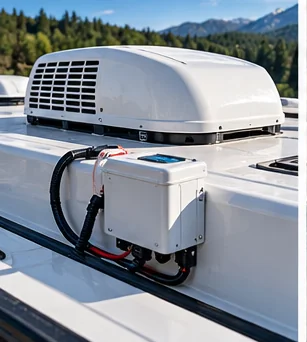
Products and configurations to compare
Micro-Air EasyStart Breeze
Micro-Air currently says all RV rooftop ACs use its Breeze family.
Best when: you want a model specifically positioned for RV/marine AC
Watch for: installation touches compressor wiring and may require professional help
RV soft-start kit with Bluetooth diagnostics
Look for model-specific compatibility documentation, not just '15k BTU' marketing.
Best when: you value app fault data for troubleshooting
Watch for: Bluetooth does not control the thermostat and does not replace electrical testing
Inverter generator sized for RV AC
Soft start reduces startup demand; it does not make undersized continuous power safe.
Best when: soft start is part of a generator strategy
Watch for: continuous running load still must fit generator capacity
Buy for compressor compatibility, not only BTU
Two 15k BTU rooftop units can use different compressor/control architectures.
Startup reduction is the reason, not extra cooling
The AC does not become more powerful; it becomes easier for limited sources to start.
Bluetooth is diagnostics, not remote climate control
Micro-Air explicitly describes the module as troubleshooting/diagnostic support.
Two ACs on 30A is situational
Micro-Air notes each AC needs its own soft start and results still depend on the rig's power-management system and total loads.
Install quality determines reliability
Secure wiring, strain relief and correct enclosure placement matter in a vibrating rooftop environment.
Soft-start hardware reduces compressor starting stress; it does not create free power
An RV air conditioner draws a large inrush when the compressor starts. A soft starter manages that transition so a generator, inverter or limited shore-power source sees a gentler startup. It does not change the running wattage into something trivial. You still need enough continuous power for the air conditioner plus every other appliance sharing the circuit.
Compatibility and wiring matter. Rooftop AC electrical work exposes line voltage and compressor wiring. Follow the exact manufacturer instructions and use a qualified RV/HVAC technician when you are not trained for the installation. Do not improvise around capacitors, control boards or branch-circuit protection.
Ventilation can reduce how often AC must run
A roof vent fan cannot replace air conditioning in extreme heat, but it can purge hot air, move cooking moisture and improve shoulder-season comfort. In many rigs the best climate upgrade is a quiet powered roof fan first, then a soft-start if the AC needs to run from constrained power.
Before checkout
- Exact RV voltage, amp service and existing component model are known
- Physical dimensions and service access are measured
- Wire, hose, port and fitting sizes are confirmed before ordering
- Product duty cycle/output matches the real worst-case load
- Cold-weather requirements are considered
- Consumables and replacement parts remain available
- Installation does not defeat factory protection or ventilation
- Mobile-app features are not required for basic emergency operation
- Return policy allows a real fit/compatibility check
- Professional installation cost is included where appropriate
Fitment and installed cost matter more than the sale price
RV equipment rarely exists in isolation. A cheaper pump that needs new fittings, a lithium battery that forces a converter change, a soft start that needs professional rooftop labor or an inverter that requires new cable/fusing can cost more installed than the premium part that actually matches the rig. Write down the entire install list before comparing prices.
Also measure service access. Components eventually need filters cleaned, bolts checked, firmware/app access, batteries changed or hoses disconnected. An installation that technically fits but cannot be serviced without dismantling a cabinet is not a good installation.
First-trip test
Test new systems close to home before depending on them several states away. Inflate every RV tire, run the pump through several faucets, cycle the AC repeatedly on the intended generator, dump through the sanitation setup, or run the inverter under realistic loads. Watch for heat, voltage drop, leaks, vibration, nuisance alarms and connection loosening. Fix those problems before the long trip.
Keep the old functional component when practical until the replacement survives that shakedown. A known-working pump, charger or level can be valuable backup while a new installation is still proving itself.
Frequently asked questions
Does a soft start lower running amps?
Its main purpose is startup/inrush management; running load still matters.
Can it let a smaller generator run RV AC?
Often that is the goal, but generator continuous output and all other loads still must be adequate.
Is EasyStart Flex the RV model?
Micro-Air's current guidance points RV rooftop applications to EasyStart Breeze and home AC to Flex.
Do I need one per air conditioner?
Yes, each compressor requires its own appropriate soft-start device.
Current manufacturer/source checks
- Micro-Air EasyStart Breeze — current RV soft-start platform
- Micro-Air EasyStart Breeze — current off-grid specs
Affiliate disclosure: RVGear.co is reader-supported. Amazon links use Associates tag scouttheory-20 and eBay links use Partner Network campaign 5339137014. We may earn a commission at no extra cost to you.