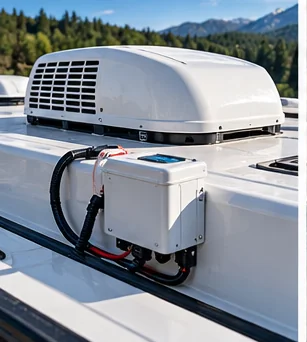
Products and configurations to compare
MaxxFan Deluxe remote reversible
Integrated cover plus thermostat/reversible operation.
Best when: you camp in humid/rainy climates
Watch for: higher upfront cost
Manual MaxxFan Deluxe
Less complexity while preserving protected airflow.
Best when: you want the rain architecture with fewer powered parts
Watch for: manual opening
RV vent cover for existing fan
Cheaper than replacing a healthy fan.
Best when: your existing fan works and you only lack rain protection
Watch for: adds height and may restrict airflow depending on cover
Rain-ready ventilation fights condensation
Cooking, showers and wet clothing can load a small RV with moisture quickly.
Integrated covers avoid a second roof accessory
Fewer separate pieces can mean simpler aerodynamics and cleaning.
Closed-lid profile matters
Measure garage/carport clearance and nearby rooftop AC/solar panels.
Thermostat is useful for pets only with broader safety planning
A powered fan can fail and cannot make a hot parked RV safe by itself.
Clean the insect screen
Airflow falls when dust and cooking film clog the screen.
Soft-start hardware reduces compressor starting stress; it does not create free power
An RV air conditioner draws a large inrush when the compressor starts. A soft starter manages that transition so a generator, inverter or limited shore-power source sees a gentler startup. It does not change the running wattage into something trivial. You still need enough continuous power for the air conditioner plus every other appliance sharing the circuit.
Compatibility and wiring matter. Rooftop AC electrical work exposes line voltage and compressor wiring. Follow the exact manufacturer instructions and use a qualified RV/HVAC technician when you are not trained for the installation. Do not improvise around capacitors, control boards or branch-circuit protection.
Ventilation can reduce how often AC must run
A roof vent fan cannot replace air conditioning in extreme heat, but it can purge hot air, move cooking moisture and improve shoulder-season comfort. In many rigs the best climate upgrade is a quiet powered roof fan first, then a soft-start if the AC needs to run from constrained power.
Before checkout
- Exact RV voltage, amp service and existing component model are known
- Physical dimensions and service access are measured
- Wire, hose, port and fitting sizes are confirmed before ordering
- Product duty cycle/output matches the real worst-case load
- Cold-weather requirements are considered
- Consumables and replacement parts remain available
- Installation does not defeat factory protection or ventilation
- Mobile-app features are not required for basic emergency operation
- Return policy allows a real fit/compatibility check
- Professional installation cost is included where appropriate
Fitment and installed cost matter more than the sale price
RV equipment rarely exists in isolation. A cheaper pump that needs new fittings, a lithium battery that forces a converter change, a soft start that needs professional rooftop labor or an inverter that requires new cable/fusing can cost more installed than the premium part that actually matches the rig. Write down the entire install list before comparing prices.
Also measure service access. Components eventually need filters cleaned, bolts checked, firmware/app access, batteries changed or hoses disconnected. An installation that technically fits but cannot be serviced without dismantling a cabinet is not a good installation.
First-trip test
Test new systems close to home before depending on them several states away. Inflate every RV tire, run the pump through several faucets, cycle the AC repeatedly on the intended generator, dump through the sanitation setup, or run the inverter under realistic loads. Watch for heat, voltage drop, leaks, vibration, nuisance alarms and connection loosening. Fix those problems before the long trip.
Keep the old functional component when practical until the replacement survives that shakedown. A known-working pump, charger or level can be valuable backup while a new installation is still proving itself.
Frequently asked questions
Can MaxxFan Deluxe stay open in rain?
Its integrated shield is designed to permit operation in rain.
Is remote control necessary?
No, but it is useful when the vent is hard to reach.
Will a cover fit any fan?
Compatibility varies by vent/fan and roof spacing.
Does more fan speed always help?
Only if replacement air can enter through windows or another vent.
Current manufacturer/source checks
Affiliate disclosure: RVGear.co is reader-supported. Amazon links use Associates tag scouttheory-20 and eBay links use Partner Network campaign 5339137014. We may earn a commission at no extra cost to you.