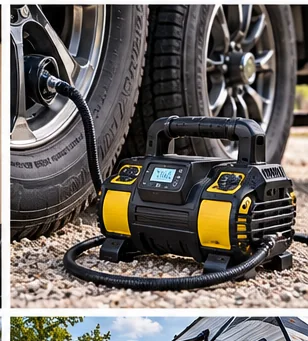
Products and configurations to compare
VIAIR 450P-RV
Current specs include battery clamps, 30-ft primary plus 30-ft extension hose and chucks for dual rear wheels.
Best when: you need high-pressure tire service and long hose reach
Watch for: 13-pound compressor plus hoses is larger than glove-box inflators
VIAIR 450P-RV EF
The current EF version keeps 150 PSI/100%-at-100-PSI duty-cycle capability while updating flow hardware and connections.
Best when: you want current enhanced-flow hardware and 45-ft total hose
Watch for: higher price and 40A fused power connector architecture
Heavy-duty digital tire gauge
Use TPMS for road monitoring and a separate gauge/inflator for setting pressure.
Best when: you want independent cold-pressure verification
Watch for: cheap gauges can drift; protect from impact
Max PSI is a poor shopping shortcut
A tiny compressor can claim 150 PSI and still take an eternity near 100 PSI because flow collapses as pressure rises. Look for fill-rate data and duty cycle at meaningful pressure.
Hose reach should cover the farthest tire without moving the compressor
Long fifth wheels, duals and toads create awkward valve access. The 450P-RV's included two-hose architecture is why it is an RV reference.
Battery clamps make sense at high current
A 23A compressor is not a cigarette-lighter accessory. Direct battery connection reduces connector heating and voltage drop.
Dual rear wheels need the right chuck
An extended 45-degree or 90-degree chuck can matter more than another 0.2 CFM when inner dual stems are hard to reach.
Heat management matters during multi-tire service
Even 100%-duty-cycle compressors get hot. Keep hoses away from the compressor head and follow cool-down/handling warnings.
RV tire service is a pressure-and-access problem
Trailer and motorhome tires often run at higher pressures than passenger-car inflators are designed to reach efficiently. The compressor therefore needs both pressure capability and duty cycle, but hose reach is equally important. A powerful compressor sitting beside the battery is useless if the hose cannot reach the far side of a long fifth wheel or an inner dual valve stem.
Air-up time also depends on what you are doing. Topping a tire from 75 to 80 PSI is a small job; recovering a large RV tire from 45 to 80 PSI after airing down is far more demanding. Buy for the hardest routine service case, not the easiest demonstration.
Pressure measurement and inflation are separate jobs
A compressor's inline gauge is convenient, but a dedicated accurate gauge is still useful for cold-pressure checks. TPMS warns while traveling; it does not replace setting cold pressure according to the tire, axle and RV manufacturer's load guidance. Treat inflator, gauge and TPMS as a system rather than substitutes for one another.
Before checkout
- Exact RV voltage, amp service and existing component model are known
- Physical dimensions and service access are measured
- Wire, hose, port and fitting sizes are confirmed before ordering
- Product duty cycle/output matches the real worst-case load
- Cold-weather requirements are considered
- Consumables and replacement parts remain available
- Installation does not defeat factory protection or ventilation
- Mobile-app features are not required for basic emergency operation
- Return policy allows a real fit/compatibility check
- Professional installation cost is included where appropriate
Fitment and installed cost matter more than the sale price
RV equipment rarely exists in isolation. A cheaper pump that needs new fittings, a lithium battery that forces a converter change, a soft start that needs professional rooftop labor or an inverter that requires new cable/fusing can cost more installed than the premium part that actually matches the rig. Write down the entire install list before comparing prices.
Also measure service access. Components eventually need filters cleaned, bolts checked, firmware/app access, batteries changed or hoses disconnected. An installation that technically fits but cannot be serviced without dismantling a cabinet is not a good installation.
First-trip test
Test new systems close to home before depending on them several states away. Inflate every RV tire, run the pump through several faucets, cycle the AC repeatedly on the intended generator, dump through the sanitation setup, or run the inverter under realistic loads. Watch for heat, voltage drop, leaks, vibration, nuisance alarms and connection loosening. Fix those problems before the long trip.
Keep the old functional component when practical until the replacement survives that shakedown. A known-working pump, charger or level can be valuable backup while a new installation is still proving itself.
Frequently asked questions
What PSI should an RV inflator support?
It should comfortably exceed the cold pressure required by your actual tires; many RV applications are 65–110 PSI and some are higher.
Is 150 PSI enough?
For many RV applications, yes, but verify your tire and chassis requirements.
Can I power a heavy RV compressor from a 12V socket?
Many high-output units are intended for direct battery clamps because current draw exceeds typical accessory outlets.
Do I still need TPMS?
Yes. An inflator sets pressure; TPMS monitors pressure/temperature while driving.
Current manufacturer/source checks
- VIAIR 450P-RV — current official specifications
- VIAIR 450P-RV EF — current official specifications
- RVGear.co — live TPMS page and affiliate wiring
Affiliate disclosure: RVGear.co is reader-supported. Amazon links use Associates tag scouttheory-20 and eBay links use Partner Network campaign 5339137014. We may earn a commission at no extra cost to you.