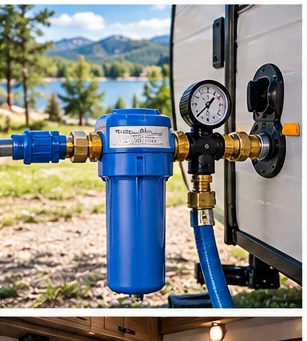
Products and configurations to compare
SHURFLO Revolution 4008
Widely supported RV demand-pump architecture.
Best when: your RV currently uses a common 3GPM/55PSI-style pump
Watch for: suffix and fittings must match
Lippert Flow Max 12V
Includes filter/connectors in current package.
Best when: 50 PSI class suits your plumbing
Watch for: higher max current than some existing pumps
Pump silencing kit / flexible hoses
Short flexible loops can isolate vibration from rigid PEX.
Best when: pump works but transmits vibration into cabinetry
Watch for: does not repair a failing pump
Photograph before disconnecting
Wiring polarity, fuse, hose orientation and strainer direction are easier to duplicate from a photo.
Do not oversize pressure casually
Higher pressure can expose weak fittings and create harsher cycling.
Pump placement needs air and service access
Do not bury the replacement where the strainer cannot be cleaned.
Leaks after replacement are often fitting problems
Thread type and swivel seals matter; over-tightening plastic fittings can make things worse.
Prime with faucets open
Follow the pump/RV procedure so air escapes instead of hammering through the plumbing.
RV water pumps are matched to plumbing, not just gallons per minute
Most replacement mistakes come from buying by flow number alone. Voltage, shutoff pressure, port type, footprint, fuse/circuit capacity and accumulator/bypass behavior all matter. A 3.0 GPM pump at 50–55 PSI can be an excellent replacement only when the RV plumbing and existing installation expect that pressure range.
Photograph the old pump label, wiring, strainer and hose routing before removal. Measure the space and confirm which fittings are threaded versus quick-connect. A quieter pump can still transmit vibration if mounted rigidly against a cabinet wall.
Fresh-water cleanliness is separate from pump performance
A strong pump does not make questionable water potable. Keep hoses, filters, tank sanitation and winterization as separate maintenance systems. Use components specifically intended for drinking-water service where applicable.
Before checkout
- Exact RV voltage, amp service and existing component model are known
- Physical dimensions and service access are measured
- Wire, hose, port and fitting sizes are confirmed before ordering
- Product duty cycle/output matches the real worst-case load
- Cold-weather requirements are considered
- Consumables and replacement parts remain available
- Installation does not defeat factory protection or ventilation
- Mobile-app features are not required for basic emergency operation
- Return policy allows a real fit/compatibility check
- Professional installation cost is included where appropriate
Fitment and installed cost matter more than the sale price
RV equipment rarely exists in isolation. A cheaper pump that needs new fittings, a lithium battery that forces a converter change, a soft start that needs professional rooftop labor or an inverter that requires new cable/fusing can cost more installed than the premium part that actually matches the rig. Write down the entire install list before comparing prices.
Also measure service access. Components eventually need filters cleaned, bolts checked, firmware/app access, batteries changed or hoses disconnected. An installation that technically fits but cannot be serviced without dismantling a cabinet is not a good installation.
First-trip test
Test new systems close to home before depending on them several states away. Inflate every RV tire, run the pump through several faucets, cycle the AC repeatedly on the intended generator, dump through the sanitation setup, or run the inverter under realistic loads. Watch for heat, voltage drop, leaks, vibration, nuisance alarms and connection loosening. Fix those problems before the long trip.
Keep the old functional component when practical until the replacement survives that shakedown. A known-working pump, charger or level can be valuable backup while a new installation is still proving itself.
Frequently asked questions
What GPM should an RV pump have?
Many common systems use around 3 GPM, but match the original design.
Can I install a higher PSI pump?
Only if the entire RV plumbing system is rated/appropriate for it.
Why is my pump loud?
Rigid mounting, hard plumbing connections and cabinet resonance often amplify normal pump noise.
Do I need an accumulator?
Not always; it can help with pulsing/short cycling in some systems.
Current manufacturer/source checks
Affiliate disclosure: RVGear.co is reader-supported. Amazon links use Associates tag scouttheory-20 and eBay links use Partner Network campaign 5339137014. We may earn a commission at no extra cost to you.