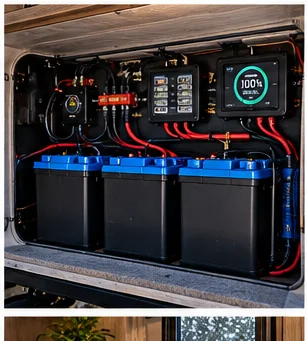
Products and configurations to compare
LiTime Group 24 Smart 100Ah
Current smart model adds low-temp protection and app monitoring.
Best when: you want light weight, Bluetooth and deeper cycling
Watch for: converter/solar/alternator charging must be lithium-compatible
Group 24 AGM deep-cycle battery
Simple, widely understood and tolerant of cold charging.
Best when: your RV charging system is built around lead-acid and usage is modest
Watch for: heavy and less usable energy for the rated Ah if preserving cycle life
LiFePO4-compatible RV converter charger
Charging hardware may be the real upgrade cost.
Best when: factory converter is not suitable for lithium
Watch for: electrical work must be properly sized/protected
Group size only describes the box envelope
Chemistry changes voltage curve, weight and charge requirements.
Lithium's flat voltage is a monitoring issue
A voltmeter is less useful for estimating SOC than on lead-acid.
Cold charging is the big seasonal distinction
The cited LiTime smart model cuts charging below freezing; self-heating variants solve a different use case.
Alternator charging deserves attention
Large lithium banks can demand sustained current from tow-vehicle/motorhome charging systems.
AGM can still be rational
Weekend shore-power campers may never recover the cost/complexity of a full lithium conversion.
State of charge is not the same as battery voltage
Under load, voltage sags; while charging, voltage rises. Lithium batteries also maintain a relatively flat voltage across much of their usable capacity. A shunt-based monitor measures current entering and leaving the bank and can estimate state of charge more meaningfully than a simple voltmeter once configured correctly.
Bluetooth inside the battery BMS can be useful, but it sees only that battery. A system shunt can measure the entire bank and all loads/charging paths wired through it. In a multi-battery installation, architecture matters more than app screenshots.
Lithium upgrades are system upgrades
Converter/charger profile, solar controller, alternator charging, low-temperature charging behavior, cable size, fusing and inverter demand all need to be compatible. A drop-in-size battery can physically fit while the rest of the electrical system remains wrong for it.
Before checkout
- Exact RV voltage, amp service and existing component model are known
- Physical dimensions and service access are measured
- Wire, hose, port and fitting sizes are confirmed before ordering
- Product duty cycle/output matches the real worst-case load
- Cold-weather requirements are considered
- Consumables and replacement parts remain available
- Installation does not defeat factory protection or ventilation
- Mobile-app features are not required for basic emergency operation
- Return policy allows a real fit/compatibility check
- Professional installation cost is included where appropriate
Fitment and installed cost matter more than the sale price
RV equipment rarely exists in isolation. A cheaper pump that needs new fittings, a lithium battery that forces a converter change, a soft start that needs professional rooftop labor or an inverter that requires new cable/fusing can cost more installed than the premium part that actually matches the rig. Write down the entire install list before comparing prices.
Also measure service access. Components eventually need filters cleaned, bolts checked, firmware/app access, batteries changed or hoses disconnected. An installation that technically fits but cannot be serviced without dismantling a cabinet is not a good installation.
First-trip test
Test new systems close to home before depending on them several states away. Inflate every RV tire, run the pump through several faucets, cycle the AC repeatedly on the intended generator, dump through the sanitation setup, or run the inverter under realistic loads. Watch for heat, voltage drop, leaks, vibration, nuisance alarms and connection loosening. Fix those problems before the long trip.
Keep the old functional component when practical until the replacement survives that shakedown. A known-working pump, charger or level can be valuable backup while a new installation is still proving itself.
Frequently asked questions
Is Group 24 lithium physically drop-in?
It can fit the battery box, but charging, cabling, fusing and cold behavior still need compatibility checks.
How much does the cited LiTime weigh?
Current specs are about 22 lb.
Can LiFePO4 charge below freezing?
Many cells should not be charged below freezing; current smart batteries often include low-temp cutoff or heating features.
Does AGM need a BMS?
No electronic BMS like LiFePO4, though the system still needs proper charging and overcurrent protection.
Current manufacturer/source checks
Affiliate disclosure: RVGear.co is reader-supported. Amazon links use Associates tag scouttheory-20 and eBay links use Partner Network campaign 5339137014. We may earn a commission at no extra cost to you.