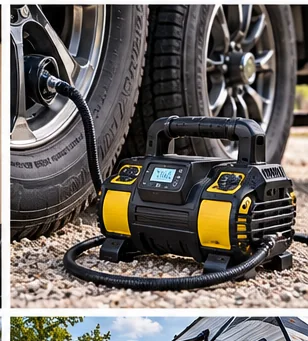
Products and configurations to compare
VIAIR 450P-RV
Current unit lists 1.80 CFM at 0 PSI, 23A max and 13.05 lb.
Best when: your rig benefits from 60 feet of included hose
Watch for: older platform but still current and highly RV-specific
VIAIR 450P-RV EF
Current EF page lists enhanced-flow technology, 23A max draw and 150 PSI maximum working pressure.
Best when: you prioritize faster fill hardware and current SAE power connection
Watch for: 45-ft hose reach is shorter than classic bundle
RV compressor hose extension
Buy only compatible pressure-rated hose/fittings.
Best when: your chosen compressor cannot comfortably reach toad/rear duals
Watch for: extra hose adds pressure drop and storage bulk
Duty-cycle parity makes the decision subtle
Both are built for sustained high-pressure work, so this is not a light-duty versus heavy-duty comparison.
Classic wins raw hose reach
Sixty feet is convenient on large motorhomes and truck-plus-trailer combinations.
EF wins newer connection architecture
The EF platform uses VIAIR's current enhanced-flow and SAE quick-connect setup.
Both still draw serious current
Plan direct, secure 12V power rather than casual accessory-socket use.
Choose by physical workflow
If you hate moving the compressor, reach matters. If you air multiple large tires frequently, fill performance becomes more important.
RV tire service is a pressure-and-access problem
Trailer and motorhome tires often run at higher pressures than passenger-car inflators are designed to reach efficiently. The compressor therefore needs both pressure capability and duty cycle, but hose reach is equally important. A powerful compressor sitting beside the battery is useless if the hose cannot reach the far side of a long fifth wheel or an inner dual valve stem.
Air-up time also depends on what you are doing. Topping a tire from 75 to 80 PSI is a small job; recovering a large RV tire from 45 to 80 PSI after airing down is far more demanding. Buy for the hardest routine service case, not the easiest demonstration.
Pressure measurement and inflation are separate jobs
A compressor's inline gauge is convenient, but a dedicated accurate gauge is still useful for cold-pressure checks. TPMS warns while traveling; it does not replace setting cold pressure according to the tire, axle and RV manufacturer's load guidance. Treat inflator, gauge and TPMS as a system rather than substitutes for one another.
Before checkout
- Exact RV voltage, amp service and existing component model are known
- Physical dimensions and service access are measured
- Wire, hose, port and fitting sizes are confirmed before ordering
- Product duty cycle/output matches the real worst-case load
- Cold-weather requirements are considered
- Consumables and replacement parts remain available
- Installation does not defeat factory protection or ventilation
- Mobile-app features are not required for basic emergency operation
- Return policy allows a real fit/compatibility check
- Professional installation cost is included where appropriate
Fitment and installed cost matter more than the sale price
RV equipment rarely exists in isolation. A cheaper pump that needs new fittings, a lithium battery that forces a converter change, a soft start that needs professional rooftop labor or an inverter that requires new cable/fusing can cost more installed than the premium part that actually matches the rig. Write down the entire install list before comparing prices.
Also measure service access. Components eventually need filters cleaned, bolts checked, firmware/app access, batteries changed or hoses disconnected. An installation that technically fits but cannot be serviced without dismantling a cabinet is not a good installation.
First-trip test
Test new systems close to home before depending on them several states away. Inflate every RV tire, run the pump through several faucets, cycle the AC repeatedly on the intended generator, dump through the sanitation setup, or run the inverter under realistic loads. Watch for heat, voltage drop, leaks, vibration, nuisance alarms and connection loosening. Fix those problems before the long trip.
Keep the old functional component when practical until the replacement survives that shakedown. A known-working pump, charger or level can be valuable backup while a new installation is still proving itself.
Frequently asked questions
Which has longer hose reach?
The classic 450P-RV currently includes 30-ft primary plus 30-ft extension hose; EF lists 25+20 ft.
Do both reach 150 PSI?
Yes, both list 150 PSI maximum working pressure.
Are both 100% duty cycle?
VIAIR lists both at 100% duty cycle at 100 PSI.
Which is better for a dually?
Both are sold with RV/dually-oriented chuck hardware; compare exact kit contents and hose routing for your rig.
Current manufacturer/source checks
Affiliate disclosure: RVGear.co is reader-supported. Amazon links use Associates tag scouttheory-20 and eBay links use Partner Network campaign 5339137014. We may earn a commission at no extra cost to you.