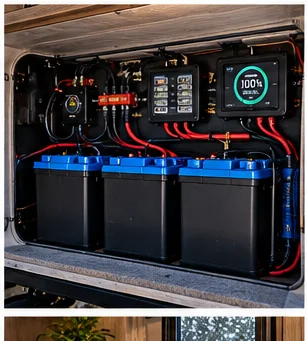
Products and configurations to compare
Victron SmartShunt 500A
Phone becomes the display; optional GX devices add remote/system integration.
Best when: your inverter/charger and all DC loads can be routed through one shunt
Watch for: installation requires correct negative-bus architecture
Victron SmartShunt 500A IP65
Current family offers IP65 versions in multiple current ratings.
Best when: installation area can see moisture/dust
Watch for: still needs protected terminals and correct wiring
Victron temperature sensor / VE.Direct cable
Aux input can be used for second-battery/midpoint/temp functions depending on setup.
Best when: you want temperature or GX integration
Watch for: buy only the accessory needed by the chosen architecture
A shunt measures current, not magic
All battery current must pass through the shunt for state-of-charge accounting to be meaningful.
500A is not a capacity rating
It is a current-measurement range; bank amp-hours are configured separately.
Bluetooth simplifies retrofit
No dedicated display cable is required for basic monitoring.
Calibration and charged-state settings matter
Wrong battery capacity or synchronization assumptions produce convincing but wrong percentages.
System architecture beats brand matching
The shunt can monitor many battery types because it measures current flow; battery-specific charge settings still matter elsewhere.
State of charge is not the same as battery voltage
Under load, voltage sags; while charging, voltage rises. Lithium batteries also maintain a relatively flat voltage across much of their usable capacity. A shunt-based monitor measures current entering and leaving the bank and can estimate state of charge more meaningfully than a simple voltmeter once configured correctly.
Bluetooth inside the battery BMS can be useful, but it sees only that battery. A system shunt can measure the entire bank and all loads/charging paths wired through it. In a multi-battery installation, architecture matters more than app screenshots.
Lithium upgrades are system upgrades
Converter/charger profile, solar controller, alternator charging, low-temperature charging behavior, cable size, fusing and inverter demand all need to be compatible. A drop-in-size battery can physically fit while the rest of the electrical system remains wrong for it.
Before checkout
- Exact RV voltage, amp service and existing component model are known
- Physical dimensions and service access are measured
- Wire, hose, port and fitting sizes are confirmed before ordering
- Product duty cycle/output matches the real worst-case load
- Cold-weather requirements are considered
- Consumables and replacement parts remain available
- Installation does not defeat factory protection or ventilation
- Mobile-app features are not required for basic emergency operation
- Return policy allows a real fit/compatibility check
- Professional installation cost is included where appropriate
Fitment and installed cost matter more than the sale price
RV equipment rarely exists in isolation. A cheaper pump that needs new fittings, a lithium battery that forces a converter change, a soft start that needs professional rooftop labor or an inverter that requires new cable/fusing can cost more installed than the premium part that actually matches the rig. Write down the entire install list before comparing prices.
Also measure service access. Components eventually need filters cleaned, bolts checked, firmware/app access, batteries changed or hoses disconnected. An installation that technically fits but cannot be serviced without dismantling a cabinet is not a good installation.
First-trip test
Test new systems close to home before depending on them several states away. Inflate every RV tire, run the pump through several faucets, cycle the AC repeatedly on the intended generator, dump through the sanitation setup, or run the inverter under realistic loads. Watch for heat, voltage drop, leaks, vibration, nuisance alarms and connection loosening. Fix those problems before the long trip.
Keep the old functional component when practical until the replacement survives that shakedown. A known-working pump, charger or level can be valuable backup while a new installation is still proving itself.
Frequently asked questions
Does SmartShunt work with lithium?
Yes, it can monitor different battery types when configured correctly.
Do I need a screen?
No; VictronConnect on phone/tablet is the standard local display.
Why choose 500A?
It is common for RV inverter systems, but size the shunt to your actual maximum DC current.
Can it monitor two batteries separately?
The auxiliary input can monitor certain second-battery/midpoint parameters, but it is not a second full independent shunt.
Current manufacturer/source checks
Affiliate disclosure: RVGear.co is reader-supported. Amazon links use Associates tag scouttheory-20 and eBay links use Partner Network campaign 5339137014. We may earn a commission at no extra cost to you.