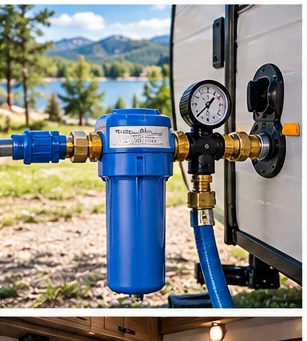
Products and configurations to compare
Mopeka Pro Check ultrasonic sensor
Direct liquid-level approach.
Best when: you want continuous app-based cylinder level
Watch for: requires compatible tank and sensor contact
Propane tank scale
Weight is direct but requires known tare weight.
Best when: you can remove/weigh portable cylinders
Watch for: less convenient on mounted RV cylinders
Inline propane pressure gauge
Useful only when understood as pressure information.
Best when: you want a simple connection indicator
Watch for: not a reliable linear fuel-level display
Propane vapor pressure is temperature-dependent
Pressure changes with temperature and remains substantial until liquid is nearly gone.
Weight is physics but inconvenient
Subtract the cylinder tare weight from total measured weight to estimate remaining propane.
Ultrasonic is the convenience layer
It estimates liquid height without removing the tank.
Two-cylinder RVs need both cylinders tracked
Automatic changeover can hide how long one cylinder has been empty.
Furnace season is where monitoring pays
Cold nights consume much more propane than refrigerator/cooking use alone.
Tank level and leak safety are different problems
An ultrasonic tank sensor estimates how much liquid propane remains. It is not a gas-leak detector, regulator monitor or emergency shutoff. A mechanical pressure-style gauge has limitations because propane pressure stays relatively stable through much of the usable fill; weight or ultrasonic liquid-level measurement gives a more direct picture of remaining fuel.
Any suspected propane leak, regulator issue or abnormal odor is a safety issue, not a shopping comparison. Shut off fuel when appropriate, ventilate, avoid ignition sources and follow RV/LP-system professional guidance.
Remote level data is most valuable before the cold night
For furnace-heavy camping, knowing a cylinder is low before bedtime is the real value. Bluetooth and display bridges are convenience layers; they do not change the underlying tank capacity or regulator behavior.
Before checkout
- Exact RV voltage, amp service and existing component model are known
- Physical dimensions and service access are measured
- Wire, hose, port and fitting sizes are confirmed before ordering
- Product duty cycle/output matches the real worst-case load
- Cold-weather requirements are considered
- Consumables and replacement parts remain available
- Installation does not defeat factory protection or ventilation
- Mobile-app features are not required for basic emergency operation
- Return policy allows a real fit/compatibility check
- Professional installation cost is included where appropriate
Fitment and installed cost matter more than the sale price
RV equipment rarely exists in isolation. A cheaper pump that needs new fittings, a lithium battery that forces a converter change, a soft start that needs professional rooftop labor or an inverter that requires new cable/fusing can cost more installed than the premium part that actually matches the rig. Write down the entire install list before comparing prices.
Also measure service access. Components eventually need filters cleaned, bolts checked, firmware/app access, batteries changed or hoses disconnected. An installation that technically fits but cannot be serviced without dismantling a cabinet is not a good installation.
First-trip test
Test new systems close to home before depending on them several states away. Inflate every RV tire, run the pump through several faucets, cycle the AC repeatedly on the intended generator, dump through the sanitation setup, or run the inverter under realistic loads. Watch for heat, voltage drop, leaks, vibration, nuisance alarms and connection loosening. Fix those problems before the long trip.
Keep the old functional component when practical until the replacement survives that shakedown. A known-working pump, charger or level can be valuable backup while a new installation is still proving itself.
Frequently asked questions
Why are cheap propane gauges misleading?
Pressure does not fall linearly with remaining liquid propane.
Is ultrasonic perfect?
No. Sensor contact, tank geometry and compatibility matter.
Can I weigh an RV propane tank?
Portable DOT cylinders can be weighed; permanently mounted ASME tanks require other methods.
Does any level gauge replace a leak detector?
No.
Current manufacturer/source checks
Affiliate disclosure: RVGear.co is reader-supported. Amazon links use Associates tag scouttheory-20 and eBay links use Partner Network campaign 5339137014. We may earn a commission at no extra cost to you.