Products and configurations to compare
Thetford Sani-Con Turbo macerator
Current family includes over-temperature protection and multiple configurations.
Best when: you regularly need long/small-hose or non-gravity routing
Watch for: motor, wiring and pump maintenance add failure points
Premium 3-inch sewer hose kit
Gravity remains the baseline for ordinary campsite dumping.
Best when: normal full-hookup/dump-station use
Watch for: requires continuous slope and bulky storage
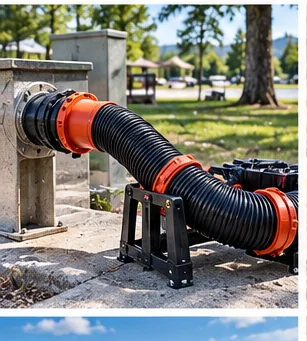
RV sewer hose support
Supports controlled fall and keeps hose off ground.
Best when: hose stays connected for days/weeks
Watch for: extra setup is unnecessary at quick dump stations
Gravity dumps faster when geometry is good
A full 3-inch path moves far more volume than a small macerator hose.
Macerators solve routing, not hygiene
The same black-water precautions still apply.
Electrical draw needs a proper connection
Do not extend or improvise DC power beyond product guidance.
A macerator can simplify home dumping
A smaller discharge hose is easier to route to a distant cleanout.
Keep a gravity backup
A pump failure should not leave you unable to empty tanks.
Gravity is simple; maceration is flexible
A standard 3-inch sewer hose moves waste quickly when the dump inlet is lower than the RV outlet and the hose has continuous fall. A macerator grinds and pumps through a smaller hose, allowing longer runs or modest uphill routing. That flexibility is useful at home cleanouts and awkward sites, but adds a motor, wiring, valves and another device that can fail.
Wear appropriate gloves, keep caps and fittings dedicated to sanitation, and disinfect tools/storage areas according to product guidance. Never create cross-connections between drinking-water gear and sanitation gear.
Sewer supports are about slope, not decoration
An accordion support keeps the hose off the ground and creates controlled fall toward the inlet. That is particularly useful on long full-hookup stays. On short dump-station visits, extra support can be unnecessary setup. Match the accessory to how long the hose stays deployed.
Before checkout
- Exact RV voltage, amp service and existing component model are known
- Physical dimensions and service access are measured
- Wire, hose, port and fitting sizes are confirmed before ordering
- Product duty cycle/output matches the real worst-case load
- Cold-weather requirements are considered
- Consumables and replacement parts remain available
- Installation does not defeat factory protection or ventilation
- Mobile-app features are not required for basic emergency operation
- Return policy allows a real fit/compatibility check
- Professional installation cost is included where appropriate
Fitment and installed cost matter more than the sale price
RV equipment rarely exists in isolation. A cheaper pump that needs new fittings, a lithium battery that forces a converter change, a soft start that needs professional rooftop labor or an inverter that requires new cable/fusing can cost more installed than the premium part that actually matches the rig. Write down the entire install list before comparing prices.
Also measure service access. Components eventually need filters cleaned, bolts checked, firmware/app access, batteries changed or hoses disconnected. An installation that technically fits but cannot be serviced without dismantling a cabinet is not a good installation.
First-trip test
Test new systems close to home before depending on them several states away. Inflate every RV tire, run the pump through several faucets, cycle the AC repeatedly on the intended generator, dump through the sanitation setup, or run the inverter under realistic loads. Watch for heat, voltage drop, leaks, vibration, nuisance alarms and connection loosening. Fix those problems before the long trip.
Keep the old functional component when practical until the replacement survives that shakedown. A known-working pump, charger or level can be valuable backup while a new installation is still proving itself.
Frequently asked questions
Does a macerator replace a sewer hose?
It replaces the large gravity discharge path for that setup, but many owners still carry a standard hose as backup.
Can a macerator pump uphill?
Powered systems can handle routing that gravity cannot, within model limits.
Which is faster?
Gravity through a 3-inch hose is generally faster when proper fall is available.
Which is easier to maintain?
Gravity hose has fewer mechanical components.
Current manufacturer/source checks
Affiliate disclosure: RVGear.co is reader-supported. Amazon links use Associates tag scouttheory-20 and eBay links use Partner Network campaign 5339137014. We may earn a commission at no extra cost to you.