The Complete RV Gear Guide
Everything you need to know before you buy — from choosing the right tow setup to sizing a solar system for full-time boondocking.
1. Understanding Tow Ratings
Every towing decision starts with three numbers: your truck's maximum tow rating (GCWR), the trailer's gross weight (GVWR), and tongue weight (TW). Tongue weight should be 10–15% of the loaded trailer weight for conventional hitches and 15–25% for 5th-wheels.
A weight distribution hitch redistributes tongue weight across all axles, improving steering and braking. Sway control — either friction-based or 4-point integrated — counteracts crosswinds and passing trucks. If your trailer exceeds 5,000 lbs loaded, a WD hitch with sway control is not optional; it's essential safety equipment.
2. Sizing Your Solar System
Start by calculating your daily energy budget in watt-hours. A typical RV with LED lights, a 12V fridge, phone charging, and a water pump uses 75–150Ah per day (900–1800Wh). A 400W panel array in full sun produces roughly 100–120Ah/day in summer, accounting for controller losses and real-world conditions.
For battery bank sizing, plan for 2–3 days of autonomy without sun. With lithium (LiFePO4), you can use 80–100% of rated capacity. With lead-acid, only use 50% to avoid damage. A 200Ah lithium bank paired with 400W of panels covers most boondocking needs. Add a 2000–3000W inverter if you want to run a microwave or air conditioner.
3. Water System Essentials
Campground water pressure varies wildly — 40 PSI at one park, 100+ at the next. A brass adjustable pressure regulator protects your pipes, fittings, and toilet valve from spikes. Set it to 45–55 PSI.
Always use a white or blue NSF-61-certified drinking water hose — never a garden hose (green). Add an inline carbon/KDF filter between the spigot and your regulator to remove chlorine, sediment, and bad taste.
4. Leveling & Stabilization
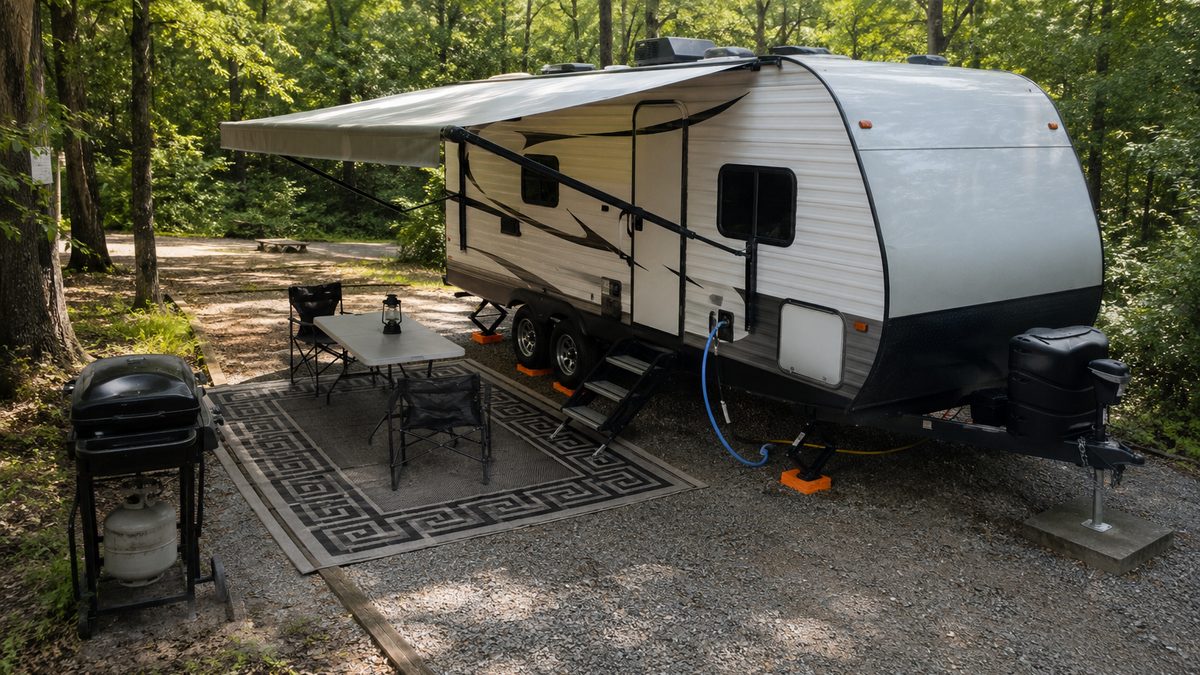
A level RV isn't just about comfort — absorption refrigerators can be damaged by running significantly off-level. You have three options: stackable blocks (cheap, universal), drive-on levelers (fast, fewer pieces), and auto-leveling systems (push-button, premium).
For stabilization, X-style scissor jacks under the frame reduce rocking. Aftermarket stabilizer kits from Camco and BAL replace the factory jacks that come standard on most trailers and are almost always an upgrade.
5. Electronics & Connectivity
An RV-specific GPS (Garmin RV series) routes around low bridges, tight turns, and propane restrictions — your phone's Google Maps does not know your rig's height. A wireless backup camera is non-negotiable for anyone towing a trailer or driving a motorhome with no rear window.
Tire pressure monitoring (TPMS) covers your tow vehicle and trailer tires in real time. A blowout at highway speed is the single most dangerous RV incident, and TPMS gives you early warning of slow leaks and rising temperatures.
6. First-Trip Checklist
Before your first trip, make sure you have the essentials covered. This is not a packing list — it's the gear that protects your rig and keeps systems running:
- Water pressure regulator + inline filter + drinking water hose
- Leveling blocks or drive-on leveler set
- Sewer hose kit with clear elbow adapter
- Surge protector (30A or 50A depending on your plug)
- Wheel chocks (pair)
- Tire pressure gauge + inflator
- Basic tool kit + spare fuses
- First aid kit + fire extinguisher
- RV-specific GPS or updated phone mount
- Backup camera if not factory-installed